
-
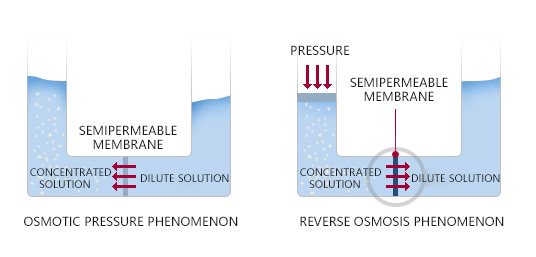 Filtration principle of reverse osmosis2017-12-07Two solutions with different concentrations are separated by a semipermeable membrane. After a period of time, the solvent of the lower-concentration solution migrates toward the higher-concentration side. The resulting liquid level difference generates osmotic pressure. Reverse osmosis applies pressure against the natural osmotic direction, which is a water purification technology allowing only water molecules to pass through the semipermeable membrane.Read more >
 -
 Difference between ion exchange demineralization and ion exchange softening2017-12-07Ion exchange desalination is intended to remove all salt-forming ions in water, so it requires the simultaneous use of strong-acid cation resins and strong-base anion resins, rather than only salt-type resins. This is because although salt-type resins can remove the original salt-forming ions in water, they generate new salt-forming ions, leaving the salt content in water basically unchanged. To remove salt-forming ions in water, the combined use of strong-acid resins and strong-base resins is essential.Read more >
 -
 Principles and Process Selection for Reverse Osmosis System Pretreatment2017-12-07Reverse Osmosis System Pretreatment Principle and Process Selection Overview of Reverse Osmosis System Pretreatment For reverse osmosis membrane elements, water sources cannot directly enter the membrane elements in most cases, because the impurities contained in them will contaminate the membrane elements, affecting the stable operation of the system and the service life of the membrane elements.Read more >
A total of: 3 page:10 page:1/1
- 1